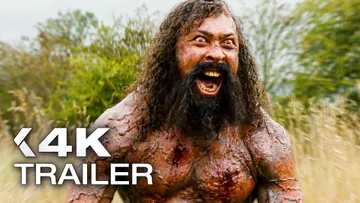
A real shock! Our review of 28 Years Later: The Bone Temple
The legendary horror series enters the next round!
With "28 Years Later: The Bone Temple", one of the most influential horror series of recent decades is back – barely a year after the release of "28 Years Later". Once again, we are immersed in a world ravaged by the rage virus, where violence is part of everyday life. But will the sequel be able to match the quality of its predecessors? And what new features should we expect? Find out in our new movie review!
The story
The story of "28 Years Later: The Bone Temple" is told in two parallel storylines, which initially run independently of each other. On the one hand, the focus is on Dr. Kelson, who is not content to regard the rage virus as a mere epidemic. Instead, he tries to understand it scientifically and psychologically – and even to control it. His most unusual approach is his attempt to build a relationship with the alpha-infected Samson.
The second strand follows Spike, who falls into the clutches of an occult group after the events of "28 Years Later". There he becomes part of cruel rituals and fights for survival. However, it should be emphasized that Spike only plays a supporting role in this sequel. The actual plot revolves around completely different characters. Of course, the two stories clash later on – but anything more would be too much of a spoiler.
This movie is unpredictable!
What sets "The Bone Temple" apart from the previous films is its narrative unpredictability. You never really know what's going to happen next – and that is both its strength and weakness. It deliberately breaks with expectations, ignores classic genre rules and relies on surreal images and absurd moments. This can be fascinating – or off-putting.
Dealing with the rage virus itself is particularly problematic. Where there used to be fear of sudden infection, the virus is portrayed as a scientifically and psychologically explainable phenomenon. As a result, it loses much of its menace – and with it the foundation on which the series once stood. Another stumbling block is the humor. Time and again, the film breaks with its menace and incorporates absurd, almost slapstick-like moments that seem like a parody of its predecessor.
Man as a true monster
Consistently with this, the infected take a back seat. Anyone expecting uncompromising zombie action in the style of its predecessors is likely to be disappointed. Instead, the film focuses on human abysses: Fanaticism, abuse of power and moral brutalization take center stage. Humans are clearly the bigger monsters here – although this insight is not really new.
In terms of violence, on the other hand, the film takes no prisoners - everything remains the same here. It may not be as explicit as its predecessor, but the R rating is more than justified.
Acting and staging as big plus points
However, "The Bone Temple" is carried above all by its actors. First and foremost Ralph Fiennes, who embodies Dr. Kelson with an impressive presence. His performance gives the character depth and makes him the emotional anchor of the film. Kelson is a man who is driven by scientific ambition and yet tries to preserve something like morality in a merciless world. In contrast to this is Jack O'Connell as Sir Lord Jimmy Crystal, for whom morality clearly seems to be a foreign concept. The leader of the gang is not a misunderstood antagonist, but a charismatic monster in human form – insane, cruel and fascinating at the same time.
The film's craftsmanship is also impressive: the images are aesthetically pleasing, the practical effects are successful and the almost surreal staging clearly sets it apart from its predecessors. In the final moments, the film even comes up with a nice surprise that definitely whets the appetite for the already confirmed third film. But we don't want to reveal any more at this point.
An unconventional experiment
To summarize, "28 Years Later: The Bone Temple" is an idiosyncratic experiment with strengths and weaknesses. The movie is off-putting, undermines expectations and departs from the origins of the series. This can be seen as courageous, but also disturbing. Despite strong acting performances, solid staging and intense moments, the overall picture seems somehow unbalanced. The bottom line is that this is a movie that tries something new, but is also likely to provoke discussion as a result.
Bottom line: "28 Years Later: The Bone Temple" is an idiosyncratic experiment with a solid presentation - but not for the masses. Fans of the old films in particular are likely to be disappointed.